
'What hurts people most is dynastic impulses and corruption under a family-ruled Congress party -- and Nehru has borne the brunt of it... I cannot be blinded by how the Nehru family has functioned but just as Gandhi can't be judged by his descendents, why should Nehru?' asks political scientist Ashutosh Varshney.

'15, 17 years back we were not even in existence in the US. Today nearly 1/3 of prescriptions written comes from India.' 'India is showing that in a very competitive environment -- like the US and Europe -- our industry is doing very well.'

'For a long time Pakistan dreamt that India would break up and that it would be the predominant power in the region,' says Colonel Anil A Athale (retd).

Pakistan has the second-largest stockpile of anti-personnel landmines in the world, a report said.

Minister for External Affairs Salman Khurshid speaks about the importance of the fourth edition of the India-US Strategic Dialogue, which he co-chaired with United States Secretary of State John Kerry in New Delhi
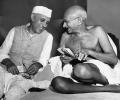
'How come with Nehru at the helm, India missed so many buses? He had such unchallenged power that he could have taken the country in any direction he wanted. The sad conclusion is inescapable that Nehru let things drift in true Hamletian ambivalence,' says B S Raghavan.

Lieutenant General J F R Jacob, Chief of Staff, Eastern Army Command during the 1971 war, revealed how, armed with only a draft surrender document and an aide, he made the Pakistani army led by Lieutenant General A A K Niazi surrender.
Lieutenant General J F R Jacob, Chief of Staff, Eastern Army Command during the 1971 war, revealed how, armed with only a draft surrender document and an aide, he made the Pakistani army led by Lieutenant General A A K Niazi surrender.
Lieutenant General J F R Jacob, Chief of Staff, Eastern Army Command during the 1971 war, revealed how, armed with only a draft surrender document and an aide, he made the Pakistani army led by Lieutenant General A A K Niazi surrender.
Lieutenant General J F R Jacob, Chief of Staff, Eastern Army Command during the 1971 war, revealed how, armed with only a draft surrender document and an aide, he made the Pakistani army led by Lieutenant General A A K Niazi surrender.

Jeremy Corbyn is a most unusual politician in these times.

Prime Minister Narendra Modi gave the vote of thanks to the President's speech on the opening day of the Budget session.

Formula One teams say they will race in Russia, despite the crisis in Ukraine and downing of a Malaysian airliner, unless the country's debut Grand Prix in October is called off or they are ordered not to go.
Lieutenant General J F R Jacob, Chief of Staff, Eastern Army Command during the 1971 war, reveals how, armed with only a draft surrender document and an aide, he made the Pakistani army led by Lieutenant General A A K Niazi surrender.
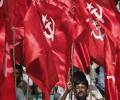
Had it not been for the intellectual dominance and political legitimacy of the Leftist philosophy since 1970, would EPW have become what it did? After all, there were other more established journals around then, says T C A Srinivasa-Raghavan.

'In her insecurity, she destroyed the institutions of democracy.' 'She packed Parliament with her supporters with loyalty being more important than ability; she superseded judges; she corrupted the civil service.' 'She knew how to use people against each other and was quite a master of that.' 'She would do this with calculated skill and in the bargain cause enmity between brothers, split up families.'
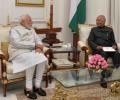
'Wisdom demands Modi moves to restore the critical institutions of the State and dial back on the cult building around his persona,' say Sonali Ranade and Shealja Sharma.

Privatisation in Russia was endorsed by technocrats. It led to the rise of Vladimir Putin.
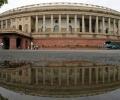
When Prime Minister Narendra Modi recently extended a Rs 8,000-crore (Rs 80 billion) central support for building roads in Jammu & Kashmir, Union Cabinet's approval for the big-ticket announcement came in barely 48 hours.

Prime Minister Narendra Modi on Wednesday "strongly disapproved" incidents of vandalism of statues in certain parts of the country and spoke to Home Minister Rajnath Singh on the matter.

Ever pragmatic, the Americans are convinced that the future is in the Indo-Pacific.
There is a new Indo-Pacific century, and India has to decide whether it has its eyes on the prize, says Rajeev Srinivasan.

News of all that's transpired on and off the football field
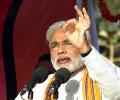
'Both reflect prejudice and short-sightedness peculiar to Mr Modi's way of thinking.'

'If you invest your entire capital in talks, you cannot abruptly change gear and decide on war.'

'Clearly, from the Indian viewpoint, the US retrenchment from Asia cannot be happening as good news.' 'The abandonment of the US' pivot to Asia exposes the US-Indian partnership to be a mere transactional relationship,' says Ambassador M K Bhadrakumar

In 1954, a bench of eight Supreme Court judges declared that the Constitution-makers did not recognise the Fundamental Right to Privacy. It is hoped that a larger bench as and when constituted will uphold the Right to Privacy as a Fundamental Right overruling the 1954 decision, says the distinguished lawyer, P P Rao.

'Even if the national security framework is to be threat-based, then the division of security threats between Pakistan and China is absurd. The two threats are one.'

The perception about JNU being 'radical' is one that is as old as JNU itself. But the university is more than just that. At its heart, its campus is a mosaic of ideologies that allow its students to breathe politically.

U R Ananthamurthy on the importance of keeping alive our regional languages.
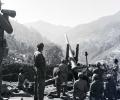
Fifty years ago, India and Pakistan fought a short but bloody war. The author finds out how Sainik Samachar, the defence ministry's journal, reported it.

'The year in pictures' treks across the globe, looking back on the moments that shaped 2016. From the United States presidential race, to demonetisation in India to the refugee crisis, the news has kept pouring in. Here are our top 50 moments from the world.

'The real test will be in defence-related deals, for instance the Javelin anti-tank missile: Is the US willing to co-develop something with India, on terms that will support the 'Make in India' initiative? Is there defence technology transfer? Or will it dump old junk on India?' asks Rajeev Srinivasan.

'We saw how vigorous democracy was when it dislodged authoritarianism under Indira Gandhi. We saw its vigour again when it voted Mr Modi out of humble origins as prime minister. It was Nehru who laid that foundation for India and what is worrying today is Modi's rather imperial style of functioning,' says writer Nayantara Sahgal.

With Beijing having had a profound rethink on India's admission as a full member of the Shanghai Cooperation Organisation, the tectonic plates of the geopolitics of a massive swathe of the planet stretching from the Asia-Pacific to West Asia are dramatically shifting. That grating noise in the Central Asian steppes will be heard far and wide -- as far as North America, says Ambassador M K Bhadrakumar.

Glimpses of the final days of the 1965 War, as seen from the diary then defence minister Y B Chavan maintained during the war.
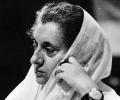
Veteran journalist Coomi Kapoor, whose book came out recently, speaks to Sheela Bhatt/Rediff.com about Independent India's darkest phase.
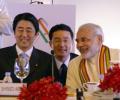
'Both nations have a common problem: A rampaging, jingoistic and hostile China which is making substantial territorial claims. In the long run, Japan and India are going to be the victims of Chinese aggression -- so they might as well hang together to contain China,' argues Rajeev Srinivasan.

'In her insecurity, she destroyed the institutions of democracy,' says Khushwant Singh.
